
Truck emergency exemptions changed on October 5, 2026, when the Federal Motor Carrier Safety Administration put a new final rule into effect.
The rule extends certain automatic federal emergency relief from 14 days to 30 days after a qualifying regional emergency declaration by a governor, an authorized representative, or FMCSA.
For trucking companies moving fuel, food, utility equipment, medical supplies, or other critical resources after a disaster, that change can affect how federal hours-of-service limits apply.
For people injured in a commercial truck crash, however, the words “emergency exemption” should not end the investigation.
The rule does not create blanket immunity for a truck driver or motor carrier. It also does not suspend every federal truck safety requirement.
After a serious collision, investigators still need to determine whether the trip actually qualified for emergency relief, which regulations were affected, how long the driver had been working, whether fatigue was present, and whether other safety failures contributed to the crash.
How Truck Emergency Exemptions Changed in October 2026
FMCSA regulates interstate commercial motor carriers through the Federal Motor Carrier Safety Regulations.
Those rules cover subjects such as driver qualifications, vehicle maintenance, hours of service, inspections, required equipment, and safe operation.
Federal law also recognizes that normal trucking rules may need limited flexibility when communities face hurricanes, floods, wildfires, severe winter weather, infrastructure failures, or other declared emergencies.
Emergency exemptions can allow qualifying carriers and drivers to provide direct assistance without being restricted by certain normal driving-time limits.
The New Rule Extends Regional Relief From 14 Days to 30 Days

FMCSA’s October 2026 final rule changes the duration of automatic relief following certain regional emergency declarations.
Under the rule, qualifying relief now lasts up to 30 days instead of the 14-day period adopted in 2023.
The rule applies when a regional emergency is declared by a state governor, the governor’s authorized representative, or FMCSA.
FMCSA explained that the change responds to requests from states and industry groups that argued some regional disasters require more than two weeks of emergency transportation support.
The change became effective immediately on October 5, 2026.
The 30-Day Rule Does Not Restore a Blanket Safety Waiver
This is the most important distinction for accident investigations.
The 2026 rule changes the duration of regional emergency relief. It does not restore the much broader automatic exemption that existed before FMCSA narrowed the rules in 2023.
For qualifying regional declarations, automatic relief generally applies to the basic hours-of-service limits in 49 CFR sections 395.3 and 395.5.
Other major safety rules remain in effect unless a separate declaration or FMCSA action specifically provides broader relief.
That means an emergency declaration does not ordinarily authorize a carrier to ignore vehicle inspection requirements, operate unsafe brakes, use an unqualified driver, or disregard other federal operating rules simply because the truck is transporting emergency supplies.
The same distinction matters in a crash claim. A carrier cannot accurately respond to every safety question by saying, “We were exempt because of the emergency.” Investigators need to identify the exact exemption and determine what it actually covered.
Emergency Relief Applies Only to Qualifying Direct Assistance
The existence of a disaster declaration also does not automatically exempt every truck operating in the affected region.
The carrier or driver must be providing qualifying direct assistance connected to the emergency response.
A truck delivering emergency fuel to an affected area may present a different regulatory situation from a truck performing an ordinary commercial shipment that happens to travel through the same state.
After a crash, investigators may therefore review bills of lading, dispatch messages, customer records, GPS history, load information, delivery documents, and the emergency declaration itself.
Those records can help answer a basic question: was this truck actually engaged in emergency relief at the time relevant to the collision?
That question may become particularly important when the carrier claims its driver was permitted to operate beyond normal hours-of-service limits.
HFM’s truck driver fatigue and hours-of-service guide explains why driver logs, dispatch schedules, fuel receipts, GPS records, and other evidence can help reconstruct how long a commercial driver had been working.
An Hours-of-Service Exemption Does Not Make Fatigue Safe
Hours-of-service rules create limits on how long commercial drivers may drive and work before taking required rest.
An emergency exemption can temporarily change how some of those limits apply to qualifying operations.
That does not mean fatigue stops mattering.
A driver may legally qualify for emergency hours relief and still become too tired to operate a tractor-trailer safely.
Fatigue can slow reaction time, reduce attention, weaken judgment, and make it harder to respond to stopped traffic, weather, pedestrians, lane changes, or other hazards.
Other Safe-Operation Requirements Still Matter During Emergencies
FMCSA’s earlier emergency-rule revisions specifically preserved other important safety requirements while narrowing automatic relief primarily to hours of service.
One example is the federal prohibition against operating a commercial motor vehicle when a driver’s ability or alertness is impaired by fatigue, illness, or another condition that makes driving unsafe.
Vehicle safety requirements also remain important.
A motor carrier responding to an emergency still needs functioning brakes, safe tires, required lights, proper inspection practices, and qualified drivers unless a specific valid exemption says otherwise.
This is why a post-crash investigation should not stop with the driver’s logbook.
If a truck could not stop, investigators may need to inspect the brake system. HFM’s 2026 truck brake failure guide explains how maintenance records, inspection reports, driver complaints, and physical components may help establish whether a mechanical problem existed before the collision.
How an Emergency Exemption Can Affect a Truck Accident Investigation
A serious truck collision during a declared emergency can create a more complicated evidence trail than an ordinary highway crash.
The carrier may argue that the driver was lawfully operating under emergency regulatory relief. An injured person may question whether the trip qualified or whether excessive working hours contributed to the collision.
Neither conclusion should be assumed without reviewing the records.
The first step is identifying the declaration that supposedly triggered the exemption.
Investigators should determine who issued it, when it became effective, which geographic area it covered, and what type of emergency assistance it addressed.
Logs, Dispatch Records, and Digital Data Can Test an Exemption Claim
Commercial trucks often produce extensive electronic records.
An electronic logging device may show driving and duty time. GPS data may identify where the truck traveled. Dispatch systems can show the assigned load and destination. Telematics may record movement, speed, braking, and route information.
Those sources can be compared with bills of lading and emergency-response records.
For example, a carrier might say that a driver exceeded normal hours because the truck was providing direct emergency assistance.
Investigators could then ask whether the load actually contained emergency supplies, where it was picked up, where it was delivered, when the trip occurred, and whether the route matched the emergency assignment.
Electronic information can also help determine what happened immediately before the collision.
HFM’s guide to ELDs, dash cams, and black box data explains how digital evidence may reveal driving time, speed, braking, GPS history, and other information after a commercial truck crash.
Preserve the Emergency Declaration Along With the Truck Records
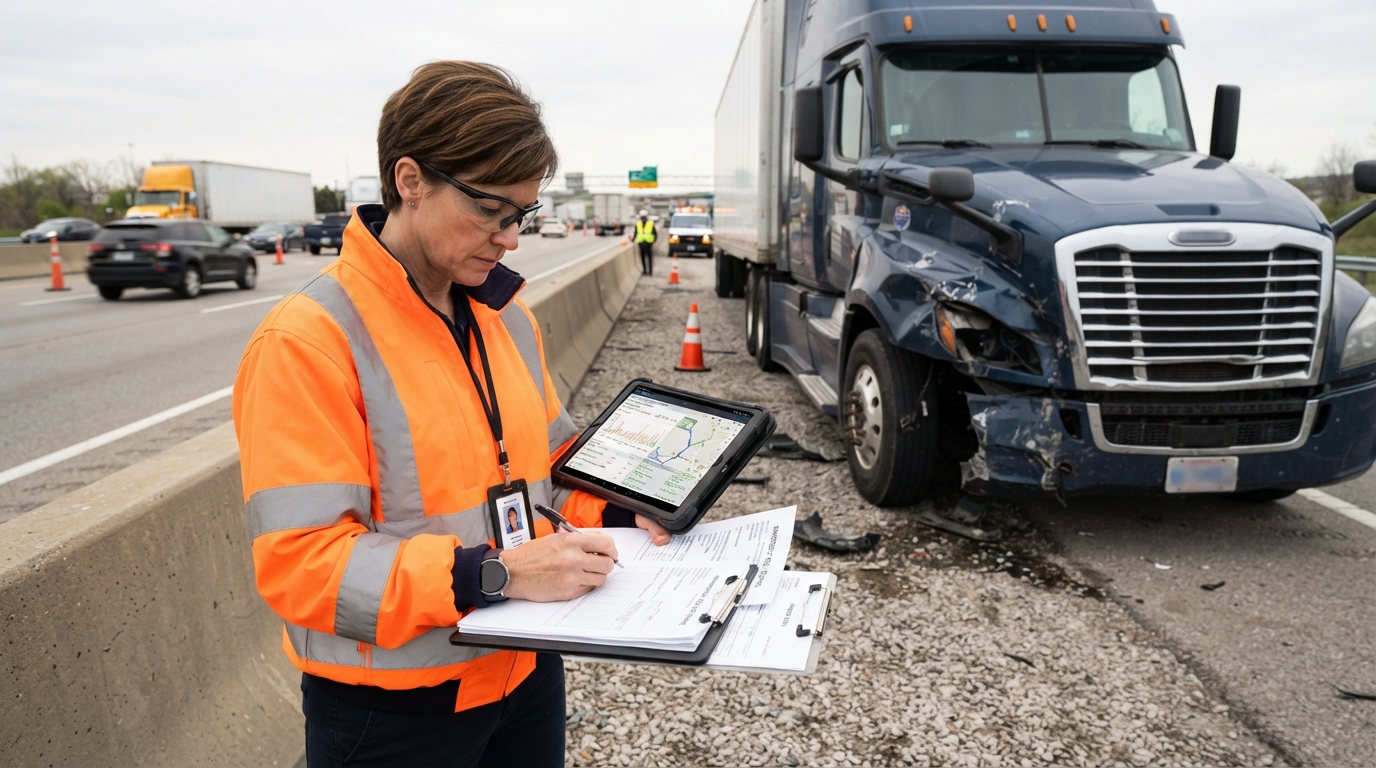
The government declaration itself can become an important piece of evidence.
Save the version that was in effect on the crash date. Later extensions, modifications, or termination notices may differ from the original declaration.
Investigators may also need to preserve carrier communications explaining why management believed the exemption applied.
Relevant records can include dispatch instructions, safety department emails, internal messages, route assignments, customer contracts, driver logs, ELD data, fuel receipts, toll records, and delivery confirmations.
Dash-camera footage should be preserved quickly because many systems overwrite older recordings automatically.
The physical truck should also be examined when vehicle condition may have contributed to the collision.
Emergency operating conditions can be demanding. Trucks may travel through storms, wildfire zones, debris, damaged roads, or unusually heavy traffic. Those conditions make proper inspection and safe operation more important, not less.
An emergency exemption also does not automatically eliminate civil responsibility.
Compliance with an exemption may help answer whether a specific federal hours-of-service rule applied, but a civil negligence claim can involve much broader questions.
Investigators may examine speed, following distance, fatigue, distraction, vehicle maintenance, route selection, company supervision, cargo loading, weather, and the conduct of other drivers.
State negligence rules and available damages also vary by jurisdiction.
truck emergency exemptions
For accident victims, the main lesson from the new truck emergency exemptions rule is therefore not that truck drivers can simply work without limits for 30 days.
The October 2026 rule is much narrower.
It extends the automatic duration of qualifying regional emergency relief from 14 days to 30 days. It does not automatically suspend every federal motor carrier safety rule, and it does not make every truck operating near an emergency exempt.
The driver and carrier must fall within the applicable emergency-relief framework.
After a crash, the records should show whether they did.
That makes the declaration, ELD records, dispatch data, bills of lading, GPS history, maintenance files, dash-camera footage, and driver condition important pieces of the investigation.
For the official final rule and current federal requirements, review the FMCSA final rule on emergency exemptions.
This article provides general educational information only and is not legal advice. Federal emergency exemptions, state negligence laws, evidence rules, insurance coverage, and filing deadlines depend on the circumstances of a particular crash and the law that applies.